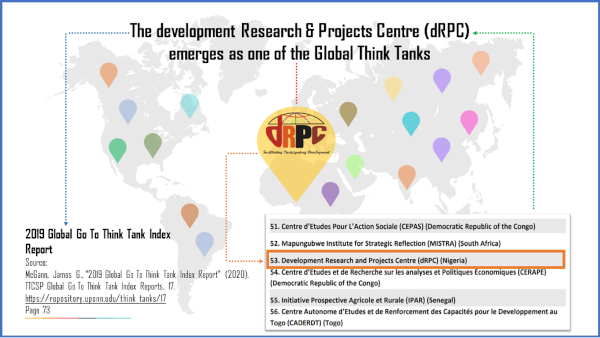
My 25 years of experience studying poverty reduction programs in Nigeria started in 2000 as an expert on the gender and poverty reduction team of the EU funding and DRN implemented, Nigeria Programming Study (NPS) in 2000. The NPS was a strategic EU funded initiative to identify programming areas for EU Official Development Assistance awards to be released upon Nigeria’s return to democracy. For context, ODA funds were held back from Nigeria during the miliary years of 1993 to 1999. I recall, well our meetings with poverty reduction gurus such as, Professor Folusho Okumadewa at the World Bank during the programming study. From my first publication on poverty reduction in Nigeria, a joint article which I wrote with Dr. Yahaya Hashim in the 2004, the book – Unpacking Policy: Knowledge, Actors and Spaces in Poverty Reduction in Uganda and Nigeria, edited by IDS scholar, John Gaventa, to recent publications, under a collaboration between the dRPC and the CPAN network, I have been on a search for models of what works in poverty reduction for about 25 years. This is the link to the 2004 publicationhttps://library.au.int/unpacking-policy-knowledge-actors-and-spaces-poverty-reduction-uganda-and-nigeria-3 and these are the links to the recent CPAN publications [ 1 ] [2] [3] [4] [5] [6] [7] [8] [9]. For context, the dRPC is a leading Nigerian non-profit dedicated to solving development challenges through research, capacity strengthening and program implementation.
On 17th October 2025, I had the privilege of accompanying the Chairman of our Board at the dRPC to a courtesy call to the Chinese Ambassador to Nigeria, His Excellency, Mr Yu Dunhai. Professor Eghosa Osaghae, the dRPC’s Board Chair is the current DG of Institute of International Affairs (NIIA).
As a student of effective poverty reduction models, I learned 5 top things from the brilliant discussions that I had the pleasure of listening and contributing to. I also left with 2 unanswered questions which I tried to answer through on-line research. So, there are the 5 top things I learned:
- That the Chinese poverty reduction strategy was not a social program. separated from the country’s economic development model; rather it was integrated into all components the country’s long-term economic growth and development policies, planning, administration and human capital strategic framework
- That poverty reduction was not viewed as a philosophical public good; rather it was a defined in technical term, as an achievable goal with milestones along the way towards full and complete achievement through eradication. For example, by 2020, China had officially eradicated extremely rural poverty.
- That rural development is a central pillar in China’s poverty reduction strategy. Rural geographies are not just pipelines of human capital for urban industrial centres but are poles of growth and transformation.
- Government – industry collaboration to set and adhere to industry related standards is critical for ensuring that the China’s education system delivers human capital with employability skills, so that graduates escape the youth poverty trap. The Ambassador gave an astonishing number of about 11 to 12 million university graduates produced annually for the labour market.
- China challenges the usual Ambassadorial posting pathways where diplomatic staff cut their teeth in Africa and move on to Western world appointments. In this case, the Chinese Ambassador’s posting reversed the Africa-Western world order as he came to Nigeria from a previous posting in the Western world. The Ambassador’s personal stories of early struggles and academic triumph was proof positive of the impact of education in China.
As important as these take-aways were, two big unanswered questions remained buzzing in my head as we said our goodbyes:
- How is China sharing the blueprint and technical components of its unique model of poverty reduction to African countries such as Nigeria with large and growing poverty populations?
- How does China work with civil society organizations in its poverty reduction and economic development models and is China also sharing its unique poverty reduction model to academics and civil society organizations from African countries such as Nigeria?
China has lifted almost one billion people out of extreme poverty in four decades. This is no easy feat. By this act alone, one country, China, has singularly accounted for the reduction of 75% in global poverty reduction. Nigeria has 63% of its population or 133 million people living in multidimensionally poverty. What can Nigeria learn from China.
My search for answers to these two big questions took me down the rabbit hole of internet research. Here is what I found out:
- That since 2005, the @International Poverty Reduction Center China (IPRCC) has been actively sharing China’s poverty reduction models and best practices to countries in Africa and other parts of the Global South. An interesting finding is that the IPRCC exist under Ministry of Agriculture and Rural Affairs and was established by the Chinese government and the UNDP with a mandate to carry out domestic and foreign poverty reduction research, exchanges cooperation, training and foreign investment project management. It was in 2021, that the Ministry of Agriculture and Rural Affairs took over poverty reduction functions following an official declaration that China had eradicated absolute poverty. Before the IPRCC poverty reduction was coordinated by Office of the State Council Leading Group of Poverty Alleviation and Development.
- That since 2005 numerous Nigerian government officials have attended trainings and seminars of the IPRCC including most recently the October 16 to 29, 2025, “Seminar on Poverty Reduction and Development” and the September 11th to 24th 2025, Seminar on Chinese Modernization and Global Shared Development
- For government officials who cannot attend IPRCC courses, the Centre has a large repository of policy focused toolkits available on its website for remote consultation as well as self and group learning. Toolkits cover areas such as identifying poverty, health poverty alleviation, education poverty alleviation, information technology and poverty alleviation and several other policy areas
The only question for which I could not find answers was whether Nigerian representatives from civil society organizations and researcher were also trained at the IPRCC. Website searches suggested that while, internally, China does fund and work with Chinese NGOs, both popular organizations and private non-enterprise unit groups, representatives of African NGOs did not seem to be participants in IPRCC trainings.
With this finding I was prompted to think that given the current African model of public-private-partnerships for development, China may well consider sharing knowledge about poverty eradicating strategies to combined cohorts of governmental and non-governmental stakeholders. Such an approach can be particularly effective, given the African reality where poverty is chronic and intersects with crises such as conflict and environmental disasters. This scenario calls for support from community-based organizations (CBOs) as government maps out responses to such crises. Moreover, because African governments such as the Nigerian government proactively engage civil society groups including CBOs, think tanks and the media, in community-based service delivery and information sharing, a case can be made for the Chinese poverty reduction trainings to introduce modules in training programs for stepdown and diffusion to local stakeholders.
The new Minister of Humanitarian Affairs and Poverty Reduction’s leadership and direction at the January 2026 maiden National Council points to a new commitment to eradicating poverty in Nigeria. As the Honourable Minister mobilizes resources, systems, human capital and finances to implement the new agenda of the Ministry, the Minister may well consider facilitating cross-learning between the graduates of the IPRCC trainings and stakeholders, including officials of state Ministries of Humanitarian Affairs and Poverty Reduction and community groups.