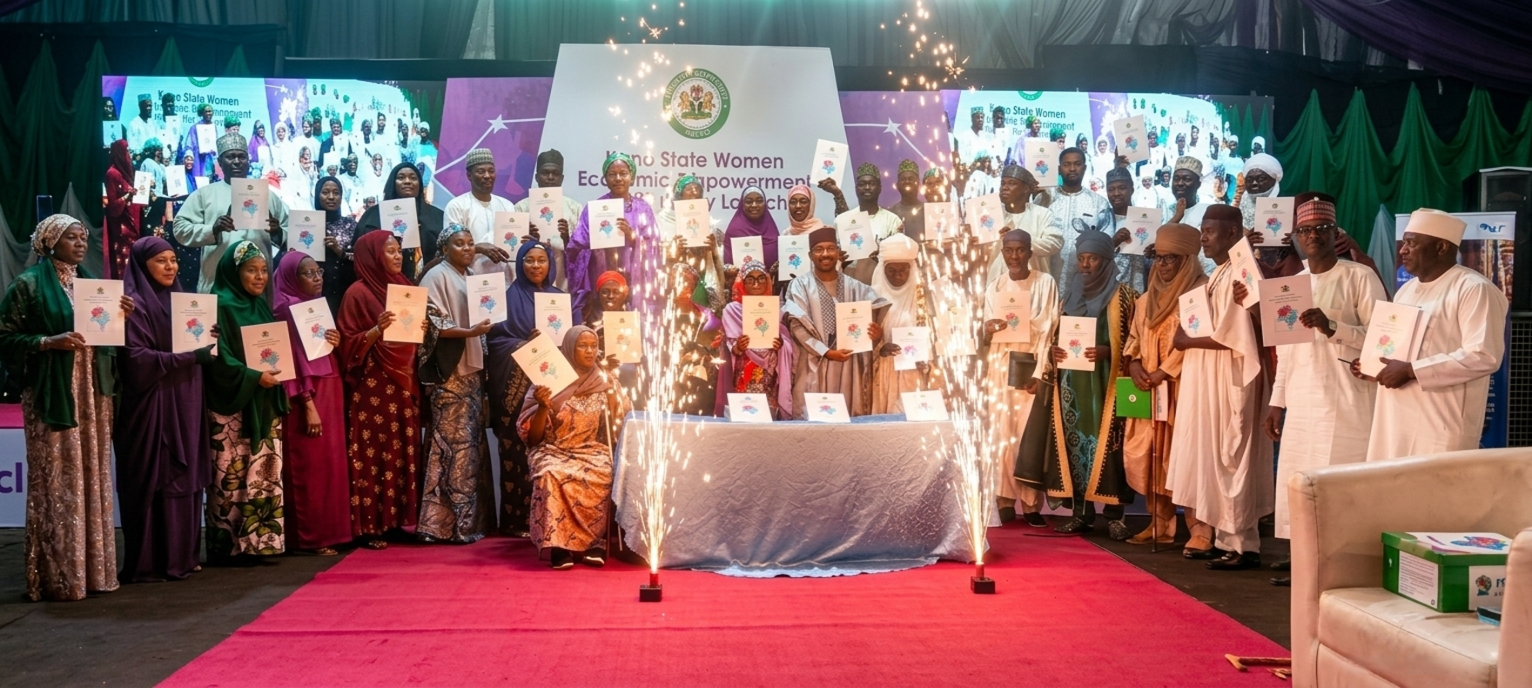
The Kano State Government on Monday, 9th March 2026 launched the Women’s Economic Empowerment (WEE) Policy in a landmark event that brought together senior government officials, traditional rulers, development partners, and private sector leaders, all united around a shared vision of inclusive economic growth. The Development Research and Projects Centre (dRPC) were a key force behind the initiative, providing the technical expertise that shaped the policy from concept to rollout.
A Policy Built on Evidence and Ambition
The WEE Policy sets an ambitious target: lifting two million women out of poverty in Kano State by 2029. It is rooted in the state government’s development blueprint, ‘Our Commitment’, which prioritizes people-centred governance anchored on dignity, justice and equal opportunity for all citizens.
Governor Abba Kabir-Yusuf, represented at the event by the Commissioner for Rural and Community Development, Abdulkadir Abdulsalam, described the launch as a defining milestone in the state’s journey toward inclusive and sustainable development.
“We are committed to building a Kano that is inclusive, just and prosperous. The policy provides direction; its success will depend on effective implementation and sustained partnerships,” the Governor stated.
dRPC’s Role: From Research to Real Impact
The development of the WEE Policy was driven by technical collaboration with dRPC, supported by funding from the Ford Foundation, the Africa Enterprise Challenge Fund (AECF), funded by Global Affairs Canada, and the WEE Catalyst Fund Kano Cohort, supported by the Gates Foundation through the Albright Stonebridge Group.
dRPC’s contribution went beyond research. Our team worked closely with the Kano State Ministry of Women Affairs, Children and Persons with Special Needs to ensure that the policy reflects the realities of women across the state’s 44 Local Government Areas, drawing on data, community engagement, and global best practices to produce a framework that is both evidence-based and context-specific.
What the Policy Delivers
Even before the formal launch, the Kano State Government had begun translating the policy into action. Highlights of the government’s commitments include:
- Monthly disbursements of ₦50,000 to 5,200 women across the 484 wards in all 44 LGAs, supporting small businesses and strengthening household economies.
- Increased budgetary allocations to the Ministry of Women Affairs to scale programmes targeting women, children and other vulnerable groups.
- Renovation of the Gyadi-Gyadi Women Skill Acquisition Centre into a hub for entrepreneurship and skills development for women and adolescent girls.
- Establishment of a dedicated department for Persons with Disabilities (PWDs), with plans for a full commission to safeguard their rights.
- Repositioning of Women Development Centres across all LGAs as grassroots engines for economic growth through skills and entrepreneurship programmes.
Key Voices at the Launch
The Emir of Kano, Muhammadu Sanusi II, lent the weight of traditional authority to the initiative, pledging the support of royal institutions in driving awareness and community-level implementation of the policy. He noted that women’s empowerment is not a foreign concept but one deeply rooted in the cultural and religious values of the Kano people.
The Commissioner for Women Affairs, Amina Abdullahi-Sani, described the policy as a historic milestone, urging development partners, civil society organizations and the private sector to align their programmes with the WEE framework for maximum collective impact.
At the federal level, the Minister of Women Affairs, Imaan Suleiman-Ibrahim, underscored the importance of the policy in advancing women’s economic self-reliance, and pledged technical guidance from the Federal Government to support effective implementation.
Several private sector organizations also pledged support at the event, including Taj Bank, Summit Bank, Alternative Bank, Bridge Connect and Phoenix Renewable Energy, focusing on capacity building, institutional strengthening and financial inclusion.
Looking Ahead
For dRPC, the launch of the WEE Policy is not the end of the journey, it is the beginning. We remain committed to supporting the Kano State Government through the implementation phase, bringing our research capabilities and development expertise to bear in tracking progress, identifying gaps, and ensuring that the policy delivers measurable improvements in the lives of women and girls across the state.
The WEE Policy represents what is possible when government, civil society, traditional institutions, the private sector, and development research organizations work together with a shared purpose. dRPC is proud to have played a central role in this milestone, and we look forward to the work that lies ahead.