The development Research and Projects Centre (dRPC) and the Women’s Health and Action Research Centre (WHARC) have commended the European Union, German government and GIZ for its continuous support to women’s political participation in Nigeria.
They made the commendation at the National Council on Women’s Affairs in Edo State this week during a joint panel session at the just-concluded 25th National Council on Women Affairs and Child Development (NCWACD) in Benin City, Edo State.
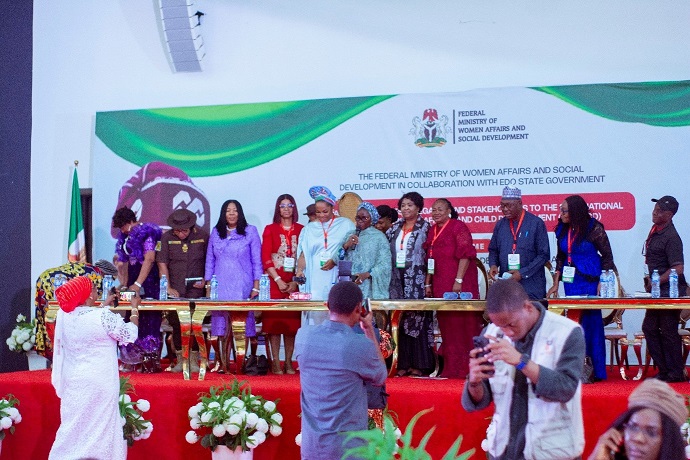
The event brought together leading scholars, gender advocates, and policymakers to discuss strategies to strengthen women’s political participation and improve governance in Nigeria.
Chaired by Professor Friday Okonofua, the panel featured Professor Anwuli Ofuani-Sokolo, who delivered a keynote address on behalf of dRPC’s Executive Director, Dr. Judith Ann-Walker, and Professor Violet Aigbokhaevbo, who served as discussant.
Dr Judith-Ann Walker described the experience of Adamawa State, where more women are allowed to partake in local governance as worthy of emulation by other sub-national governments.
‘In Adamawa State, we saw how 20 of the 21 local councils have women as Vice chairs, with a woman elected to lead one of the biggest councils in the state. This is apart from several women in positions of power, she added.
She then commended GIZ, the European Union, and the German government for supporting women’s participation in Borno and Adamawa states through the Sustainable Social Protection Participation and Economic Resilience programme, where the dRPC trained over 60 media practitioners and elected women politicians on gender-responsive governance.
Earlier, speakers at a panel highlighted deep-rooted barriers facing women in politics, including restrictive gender norms, economic constraints, and structural inequalities within political parties. Professor Aigbokhaevbo noted that women seeking political office are often stigmatised for stepping outside traditional roles. At the same time, Professor Ofuani-Sokolo emphasised the need for constitutional reforms and stronger community support systems.
Both panellists underscored the importance of engaging male allies, the media, and political party leaders to shift norms and create enabling environments for women’s leadership.
WHARC also shared advocacy materials with participants, including gender data from local government and state assemblies. The session featured active contributions from attendees, who shared experiences and asked questions on how to promote women’s political inclusion effectively.
In closing, Professor Okonofua called for increased support for women aspiring to political office and encouraged women to back one another in leadership pursuits.
Earlier, the Minister of Women Affairs, Hajiya Imaan Suleiman-Ibrahim, described the theme of the council, Strengthening Systems and Deepening Social Impact: Advancing the Renewed Hope Agenda for Women, Children, Families and other Vulnerable Groups, as a signal to the commitment of President Bola Ahmed Tinubu to ensure a prosperous Nigeria, especially for women and the girl child.