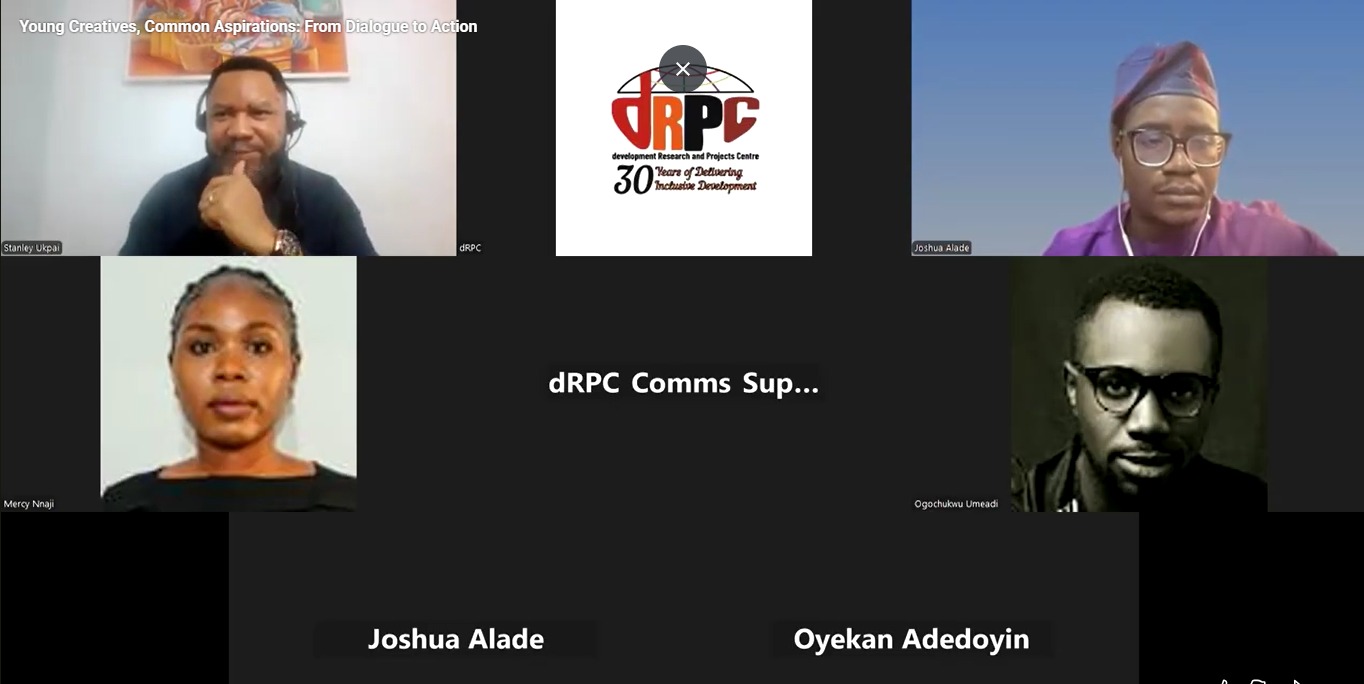
Young creatives, policymakers, development practitioners and government representatives gathered for a webinar dialogue convened by the development Research and Projects Centre (dRPC) to mark International Youth Day, with a shared focus on strengthening Nigeria’s creative economy and building lasting networks for youth-led growth. The event, themed “Young Creatives, Common Aspirations: Building from Dialogue to Community,” explored how collaboration, policy engagement and community-building can help turn creative talent into sustainable livelihoods.The dialogue aligned with this year’s United Nations International Youth Day theme, “Different Contexts, Common Aspirations,” which recognises that while young people’s experiences differ widely, they share common goals of opportunity, dignity, meaningful participation and sustainable economic advancement.
A Sector Under the National Spotlight
The event came at a moment when Nigeria’s creative economy is drawing growing national attention. Since 2024, President Bola Tinubu has repeatedly pointed to the sector as a key pillar of economic diversification and national development — at the launch of the 2024 Abuja International Carnival, the 2025 unveiling of the Nigerian Youth Academy (NIYA GIGS) Platform and Grant Award Ceremony, and the 2026 Nigerian Modernism exhibition at Tate Modern, London – underscoring the role of the creative industries in driving growth, innovation and global competitiveness.
Government Signals Growing Institutional Interest
Delivering goodwill remarks on behalf of the Federal Ministry of Youth Development, Mr Oyekan Adedoyin, Head of Department for Youth Migration and Climate Action Resilience, described the gathering as both a celebration of International Youth Day and a milestone in dRPC’s work to advance inclusive development. He noted that Nigerian youth are already shaping the future through innovation and enterprise, and called for stronger collaboration among government, civil society and the private sector to ensure youth-driven ideas translate into real policies and opportunities.
Representing the Federal Ministry of Art, Culture, Tourism and the Creative Economy (FMACTCE), Mr Eze Osuji, Principal Planning Officer in the Ministry’s Planning, Research and Statistics Department, opened by highlighting the strategic importance of young creatives to Nigeria’s future. He pointed to initiatives such as dRPC’s national dialogue on youth creatives in the digital economy as evidence that talent, when backed by the right infrastructure, policy and partnerships, can become a genuine pathway to economic empowerment and sustainable livelihoods.
The conversation’s significance was reinforced further by representatives of the National Institute for Policy and Strategic Studies (NIPSS), whose Senior Executive Course 48 is currently examining Nigeria’s orange economy at the directive of the Presidency – a sign that the creative economy is now a recognised national policy priority.
A ₦1.97 Trillion Sector With a Blind Spot
Speaking on the sector’s economic potential, dRPC’s Director of Projects, Dr Stanley Ukpai, cited figures showing that Nigeria’s creative economy contributed at least ₦1.97 trillion to GDP in 2025, with projections pointing to average annual growth of 8.6 percent through 2028 – placing it among Africa’s most dynamic growth industries. But he was equally clear about the challenges still holding it back, chief among them widespread copyright infringement and weak intellectual property protection, which continue to limit earnings and growth opportunities for young creatives. He stressed the need for greater awareness, support and access to IP registration and advisory services to help Nigerian creatives successfully monetise their work in global markets.
A Youth Policy Still Being Written and Still Open to Input
Participants also explored opportunities for youth engagement in public policy. Mr Joshua Alade, Founder of Nigeria Youth SDGs, presented insights into the forthcoming National Youth Policy (2026–2030), currently undergoing stakeholder consultation. He encouraged young creatives to actively contribute to the policy process and advocate for measures addressing financing, market access, skills development, fair contracts and social protection – talent alone, he said, is not enough without the systems and support structures creatives need to thrive.
Ogochukwu Umeadi of Twenty Pounds Entertainment added practical industry perspective, sharing lessons from building a creative career in Jos, including infrastructure deficits, limited collaboration opportunities, and the need to distinguish genuine opportunities from exploitative arrangements. He urged participants to cultivate visibility, invest in personal branding, and focus on long-term growth rather than shortcuts to success.
A major outcome of the event was renewed commitment to formalising the network of creatives that has emerged from dRPC’s previous engagements, including its national dialogue on youth creatives in the digital economy and related NIPSS discussions on the orange economy. dRPC’s Mercy Nnaji highlighted that four creatives have already benefited from intellectual property scholarships facilitated through earlier engagements, and invited participants to help shape the proposed network’s governance, identity and strategic direction.
Participants were clear that the network should be inclusive of all creative disciplines – from advocacy for preserving indigenous cultural heritage through projects documenting oral histories, to calls for greater visibility, mentorship, funding opportunities, and stronger pathways connecting creative skills with markets. Several stressed the importance of positioning young people not only as beneficiaries of policy interventions, but as active contributors to policy design and implementation.
Closing the event, Dr Ukpai thanked representatives of the Federal Ministry of Youth Development, FMACTCE, NIPSS, panellists and participants for their contributions, and encouraged young creatives to sustain the conversations begun at the dialogue and keep building the connections that can drive collective growth and influence policy. He reaffirmed dRPC’s commitment to supporting youth creativity, innovation and sustainable development.
In the Media
- Weak copyright protection could undermine Nigeria’s N1.97 trillion creative economy – Experts, Premium Times, 19 August 2026
- dRPC seeks robust policy to support young gig economy creatives, The Guardian Nigeria, 18 August 2026
- Full Event Recording, Youtube